
Unlimited Calculator
Exact answers, real units, and symbolic algebra.
![The Mac calculator in light mode — a display card reading 1.2569/9 with the approximate answer 0.139655555556 beneath it, the scientific keypad below with sin, cos, tan, ln, log, factorial, nCr, nPr, mean and stdev, and the tape beside it: 1/3 + 1/6 answered exactly as 1/2, 3.5 ft converted to flightlevel, 60 mph times 2 h given in miles, 120 W times 3 h in kWh, 360! and 100! as exact integers, solve(x^2 = 4, x) as [−2, 2], and a line the app declines with “this is not something I can evaluate”](calculator-mac-tape.png)
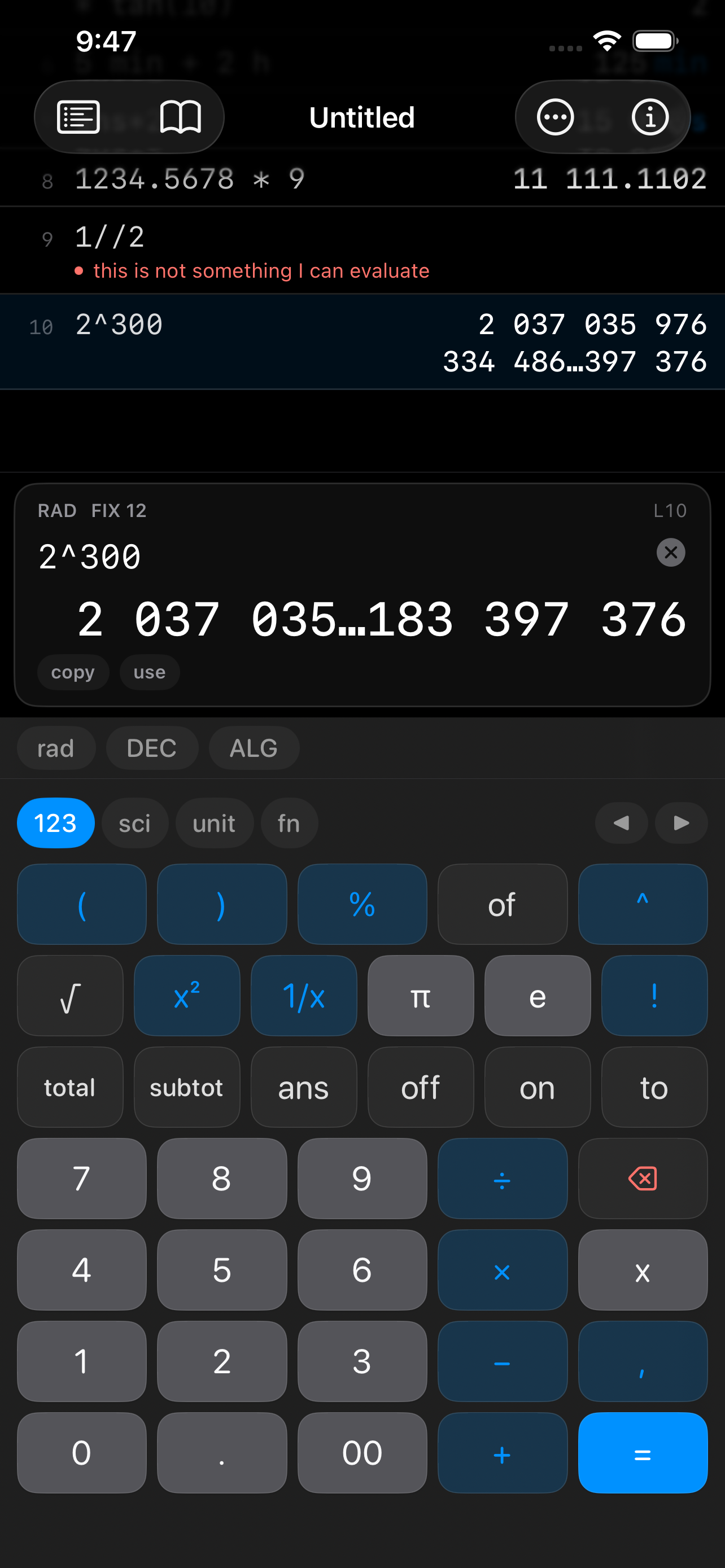
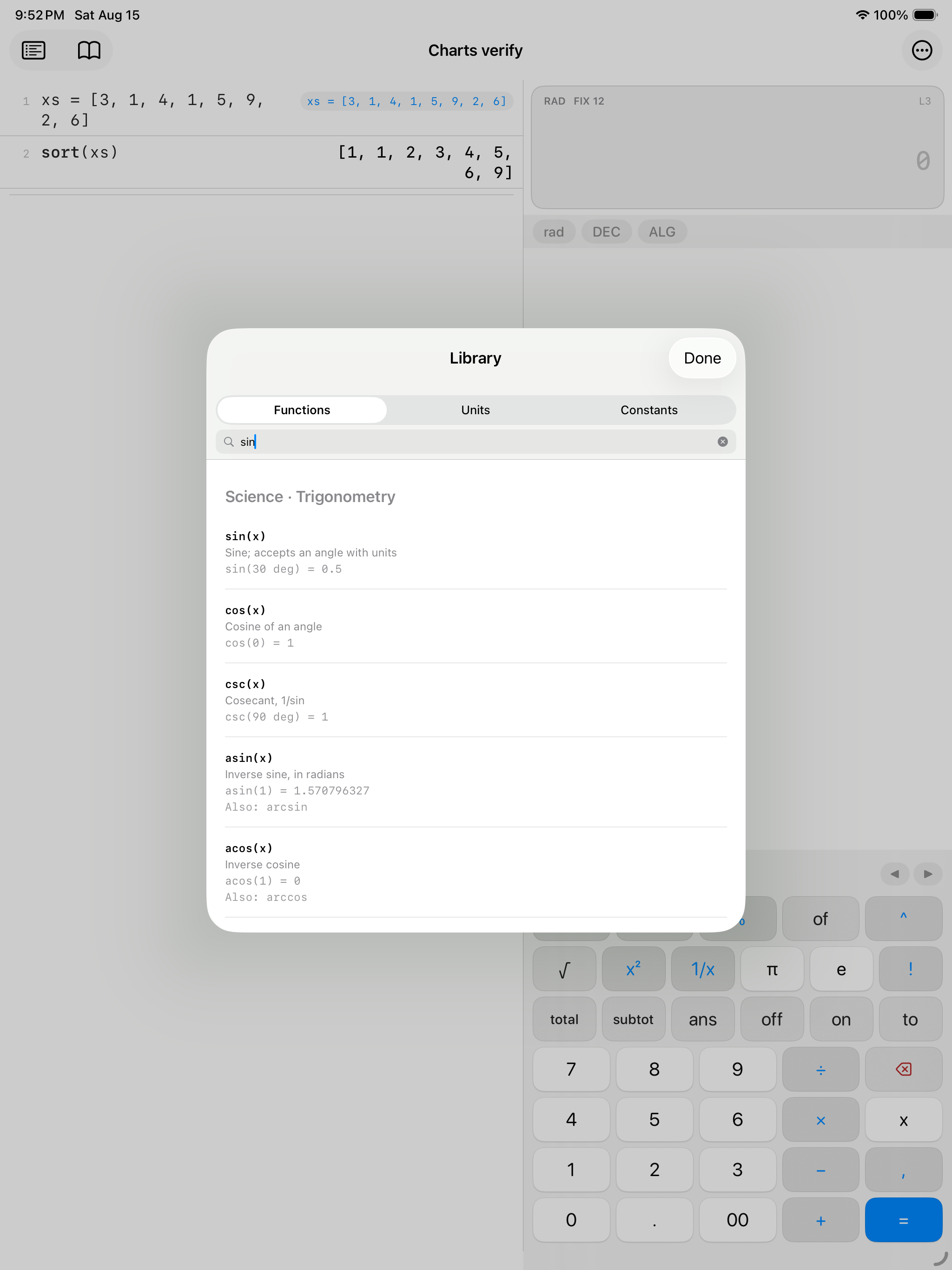
![The tape on iPad — a sheet named ‘Charts verify’ where xs = [3, 1, 4, 1, 5, 9, 2, 6] on line 1 and sort(xs) on line 2 returns [1, 1, 2, 3, 4, 5, 6, 9], beside the RAD FIX 12 result card and the full keypad](calculator-ipad-tape.png)

A calculator that does not round unless you ask it to. Type an expression and get the exact answer: a fraction stays a fraction, a root stays a root, and a number with a unit keeps that unit through every step. Solve, differentiate, integrate, and factor symbolically, then plot the result.
Arithmetic that doesn’t lie
- Exact at any size — whole numbers and fractions with no limit.
200!gives every one of its digits,2^1000just as many, and 1/3 stays 1/3 with no floating-point drift. - Decimals mean what you typed — 0.1 + 0.2 is exactly 0.3.
- Exact or decimal, your choice — show any result as a decimal at the precision you pick. Ask for fifty places and all fifty are right.
- Programmer bases — every base from 2 to 36, with bitwise operations at any size. Complex numbers work everywhere.
- Tested, not guessed —
isprime(2^61 - 1)returns true because the number was tested, andfloat(1/7, 40)gives forty correct digits. - Approximation is marked — an answer that is not exact carries a ≈. No mark means the number is exactly right.
Units that carry through
- Type it like you say it —
3.5 ft to m,60 mph * 2 h, or(120 W * 3 h) to kWh. The answer comes back with the right unit. - Every quantity — length, mass, time, area, volume, pressure, energy, power, force, speed, data size and rate, angles, and temperature with its offsets handled correctly.
- Domain units — astronomical distances, nuclear energies, molar quantities, and aviation units.
- Physical constants by name — each with its unit, and with its uncertainty where the SI does not fix it exactly.
- Dimensional honesty — metres plus kilograms is an error, not a number. Conversions between exact units are computed as fractions, so
1 mi to ftis 5280 exactly.
Algebra, not just arithmetic
- Simplify, expand, and factor — work with expressions, not just numbers.
- Solve exactly — when a root is irrational, the root is kept:
solve(x^2 = 2, x)answers ±√2. - Calculus — symbolic derivatives, integrals, limits, and series expansions.
- Matrices — exact determinants, inverses, ranks, and eigenvalues.
- Plot from the answer — plots break where the function is undefined instead of drawing a line through infinity.
A tape, not a screen
- Every entry stays — visible, editable, and ready to run again. Change a line and everything below it updates.
- Name things — assign variables, define your own functions, and keep them per document. Change a definition and every line that used it recomputes.
- A knob on any number — select a
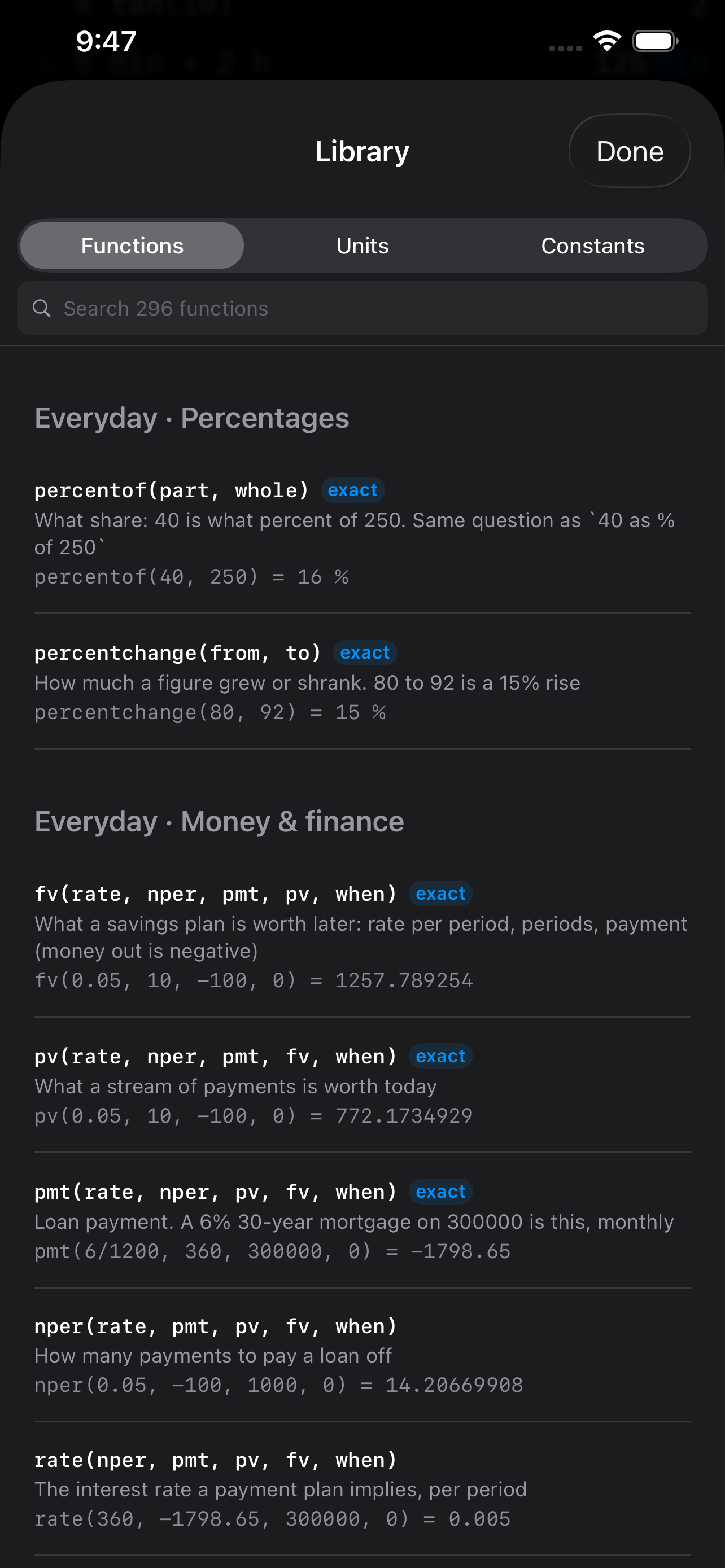
name = numberline and the inspector grows an Adjust slider. Drag it and the whole tape moves with it. - A library you can read — hundreds of functions, hundreds of units, and every constant, each with a one-line explanation and a worked example, one tap from your line.
- A report others can audit — preview and export a standalone HTML worksheet that pairs every result with its source, marks approximations and issues, and records the calculation settings.
- Exact by default — approximation is a choice you make, not one made for you.
One purchase, every device
One purchase covers Mac, iPhone, and iPad.
No account, no subscription, no in-app purchases, no ads, no analytics, and no tracking. Every computation runs on the device.
Your tapes stay on your device. The one network request the app makes is to fetch the European Central Bank’s public daily exchange-rate file, and only when you refresh currency rates.